

by Kendra Walz
A couple of weeks ago, I wrote a blog post investigating the “Jewish saints” discussed in Michael Frank’s book, One Hundred Saturdays, which explores the Sephardic Jewish community on the island of Rhodes. In that post, I noted that the only “Jewish saint” I could think of was Saint Edith, a Jewish woman canonized by the Catholic Church. This begs the question: how does a Jewish person get canonized by the Vatican and become a Catholic saint?
Like all Catholic saints, Saint Edith was a real woman–her full name was Edith Stein. She wrote an autobiography, Life in a Jewish Family, and has been described as “the most influential German-Jewish woman of the 20th century.” She built a successful career as a writer, nurse, and teacher, eventually earning a doctorate in philosophy. However, her life was abruptly cut short when she was deported to Auschwitz in 1942, where she was murdered.
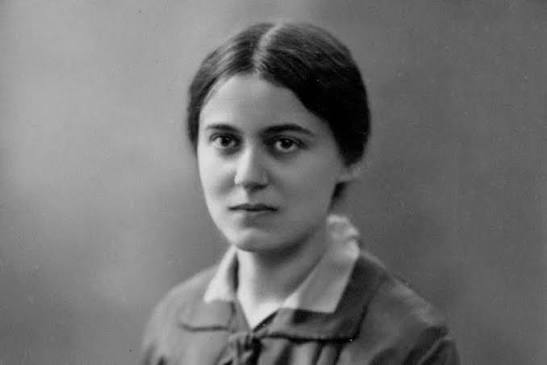 Photo courtesy of Elizabeth Mitchell
As an adult, Stein converted to Catholicism and became a nun. She was not just any nun, she was a Carmalite nun. Following the horrors of Kristallnacht, she and her sister Rosa (who had also converted) fled to a secluded convent in the Netherlands. When Dutch Catholics loudly denounced Nazi occupation and deportations of Jews, the Nazis retaliated by targeting Jewish converts, which included Edith and her sister. Some of Edith’s writings, as well as testimony from her fellow nuns at the convent, suggest Edith predicted she would not survive the war and prepared a will. She reportedly said to her sister “we are going for our people” as they were being deported.
In order for an individual to become a saint in the Catholic church, there are multiple criteria that need to be met. One condition is that the individual must be deceased, and the manner in which they died must be considered martyrdom–that they willingly died in defense of the Catholic faith. This is where Edith Stein’s canonization becomes strange and controversial; she was not killed for the Catholic faith, she was killed because she was a Jew. Although she may have accepted she was going to die, she did not die willingly, she was a victim of the Holocaust and targeted Jewish persecution.
When the Catholic Church canonized her in 1987, Pope John Paul II referred to her as both “an eminent daughter of Israel” and “a faithful daughter of the Church.” The Pope even explicitly acknowledged that she was killed because she was Jewish, using the occasion to call on the Church to remember the Shoah. Yet, this acknowledgment directly contradicts the Church’s theological justification for her martyrdom: the claim that she died for Catholicism because her arrest was a direct retaliation against the Dutch Church’s anti-Nazi statements.
Edith Stein is among the most controversial saints, and her canonization has been heavily debated by Jews and Christians for decades. Edith Stein was indeed a philosopher–the questions surrounding the duality of her identity and how Jews and Catholics view her remains a topic of great philosophical discussion.
For more discussion on the intersectionality of the Abrahamic faiths, be sure to check out Scott Shay’s book In Good Faith: Questioning Religion and Atheism and visit the Chai Mitzvah website for a free copy and discussion guide to bring to your next Jewish book club meeting.
Kendra Walz, Chai Mitzvah’s Administrative Services Manager, has a background in non-profit management and grant administration. She graduated with an MBA in International Business from the University of Hartford in 2026. She volunteers with multiple Jewish organizations in the Greater Hartford area and Israel and has been published in the Jewish feminist magazine Lilith.
West Hartford, CT
860.206.8363
info@chaimitzvah.org


Copyright © 2026 Chai Mitzvah. All rights reserved. Website designed by Addicott Web.
Leave a Reply