


by Kendra Walz
Recently, on a road trip to Toronto, somebody said something to me that I found to be odd. They said that decorating a prayer book was “a big no-no”, in reference to the rules of Judaism. I found this to be a surprising claim considering that all siddurim I have seen appear to be beautifully decorated. On this very trip, I took a picture alongside a Torah from Baghdad that was inside an intricately decorated silver case. Perhaps the Torah itself was not decorated, but I also remembered back to the illustrated Torah I saw at the MET a few years ago, with beautiful elaborate paintings on the pages. I immediately thought of my own siddur, which I purchased from a stall at the shuk in Jerusalem from an Orthodox man who offered to engrave my name onto it. The siddurim in his stall came in a variety of colors and decorated covers.
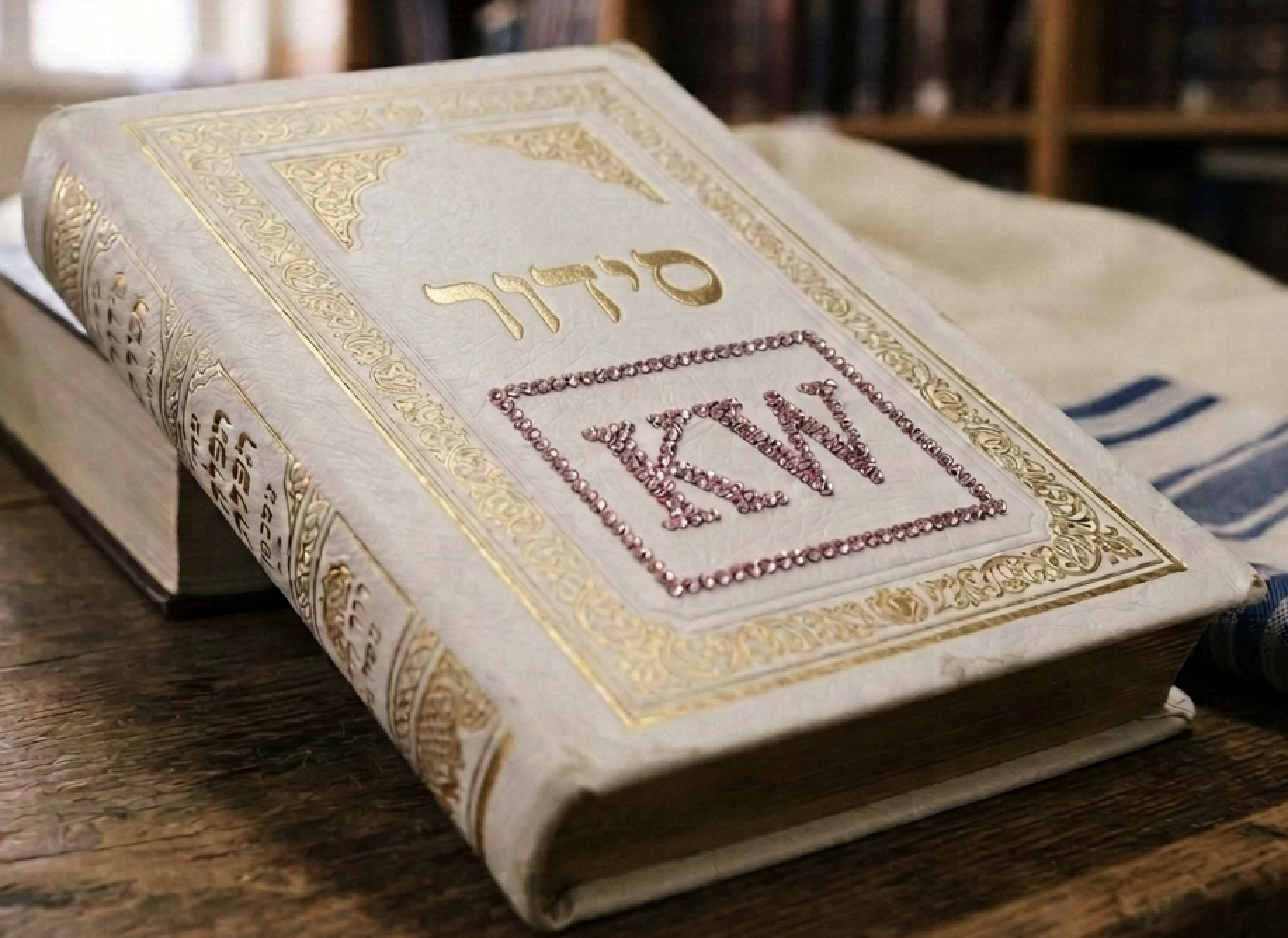
Even before I bedazzled my initials onto this specific siddur, the cover had already been decorated with detailed embossed designs. I was wondering where in Jewish tradition did it say that decorating a
siddur was “a big no-no.” I have already written a blog post on chiddur mitzvah that discusses the beautification of Judaica. My assumption was that the wide selection of decorative siddurim at this stall in Jerusalem was an example of that. But opinions and interpretations of what Judaism says about decorating a prayer book will inevitably vary from Jew to Jew, so I set out to investigate where
in our people’s history was bedazzling a siddur declared to be “a big no-no.”
I found a book called Shemirat Kevod Sefarim, “keeping the honor or respect of books,” which is supposed to detail everything one may need to know about what Judaism says about treating books. While one should not leave their books open when they leave the room, nor should they set them face down on a table, nor should they use them to tap someone’s shoulder or nudge something that is
just out of reach- I failed to find any citations from this book or other sources that forbid one from decorating the cover of a holy book.
Historical precedent tells us that Jews of ancient times have long held the tradition of binding siddurim in ornate covers. This, of course, most likely falls under chiddur mitzvah. Perhaps it may vary across sects and denominations, and one should consult with their own rabbi if they are unsure.
From my perspective, creating art and adding decorations to our precious items is a deeply human tradition of transforming the ordinary into extraordinary.
Kendra has a background in non-profit management and grant administration. She graduated with an MBA in International Business from the University of Hartford in 2026. She volunteers with multiple Jewish organizations in the Greater Hartford area, and Israel, and has been published in the Jewish feminist magazine, Lilith.
West Hartford, CT
860.206.8363
info@chaimitzvah.org


Copyright © 2026 Chai Mitzvah. All rights reserved. Website designed by Addicott Web.
Leave a Reply