

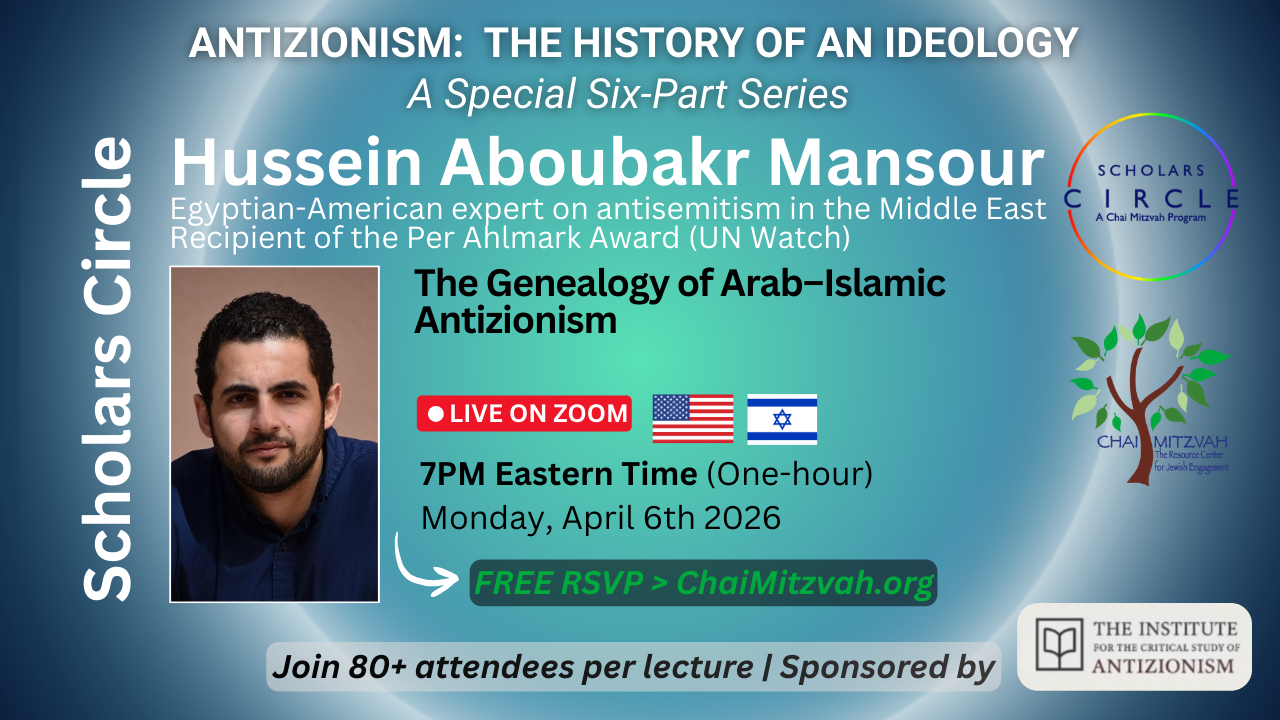
This lecture is part of Antizionism: The History of an Ideology, a six-part series hosted by Chai Mitzvah. The series examines the historical origins, evolution, and contemporary manifestations of antizionism. Sponsored by the Institute for the Critical Study of Antizionism.
Contemporary antizionism in the Arab and Muslim world is neither an organic expression of religious tradition nor a spontaneous political response to the founding of Israel. It is an engineered ideological formation—constructed by intellectuals, institutionalized by states, and propagated through deliberate networks of cultural production. This lecture traces the genealogy of Islamic antizionism from its theological antecedents to its modern systematization, arguing that the distinctively conspiratorial and eliminationist character of contemporary Islamic anti-Jewish discourse emerged from a specific historical synthesis: the grafting of European racial antisemitism onto traditional Islamic frameworks of Jewish subordination. An essential role was played by Western-educated Arab intellectuals importing the Protocols of the Elders of Zion and Nazi propaganda and translating them into Islamic forms. Arab nationalist regimes subsequently instrumentalized this discourse, sponsoring its production while harboring former Nazi personnel who continued their work under new flags. Ultimately, this ideological synthesis became the foundation of modern Arab political culture, thought, and mass society.
Hussein Aboubakr Mansour is an Egyptian-American intellectual specializing in modern intellectual history. In 2012, he had to flee his home country, Egypt, due to the persecution he faced because of his vocal work against antisemitism. His current work focuses on Arab political thought, Arab intellectual history, and the globalization of antisemitism and revolutionary radicalism. Hussein previously served as an assistant professor of Hebrew language and culture at the Defense Language Institute in Monterey, California. His writings have appeared in Commentary, Tablet, Mosaic, and the Athens Review of Books. Hussein is a sought-after commentator and speaker on issues of antisemitism and extremism in the Middle East. In 2022, he was awarded the Per Ahlmark Award by the UN Watch for his advocacy for human rights, and in 2024, he was awarded the German Mercator Fellowship from the Hochschule für Jüdische Studien in Heidelberg. He is a Fellow at The Elizabeth and Tony Comper Interdisciplinary Center and a Fellow at the Z3 Institute.
West Hartford, CT
860.206.8363
info@chaimitzvah.org


Copyright © 2026 Chai Mitzvah. All rights reserved. Website designed by Addicott Web.