

By Jennifer Saber
I live with regret. A 35 plus year old regret.
When I was in elementary school, my childhood synagogue, Park Synagogue in Cleveland, Ohio, loaded up buses and headed to Washington, D.C. for an event connected to Soviet Jewry. All these years later, what I remember most is not the cause, which at the time I did not fully understand. It is the feeling that I missed out.
Not because I had some deep, principled reason. My “activism” at that age was pretty simple: they packed peanut butter and jelly sandwiches for lunch, and my friend Rachel Klein got to go, and I did not.
Fast forward 35 plus years.
The other day, when I realized my next blog was going to be posted on MLK Day, I wanted to write something full of inspiration and a clear call to action for the reader. I wracked my brain for a big moment from my own life to hold up as an example. I came up empty. No grand gestures. Just a list of missed opportunities.
I skipped a recent chance to go to our state capitol in Madison to support a bill related to Holocaust education. I also scrolled past posts on social media as our local Jewish social justice organization hit the streets during the last election to canvas neighborhoods and register voters. I never reached out to join them.
Instead of beating myself up, I found myself thinking about a warning I once heard from Rabbi Joachim Prinz.
We all know Dr. Martin Luther King Jr.’s “I Have a Dream” speech, but how many of us have rewound that black and white footage a few minutes to listen to the speech delivered from the same podium just moments before?
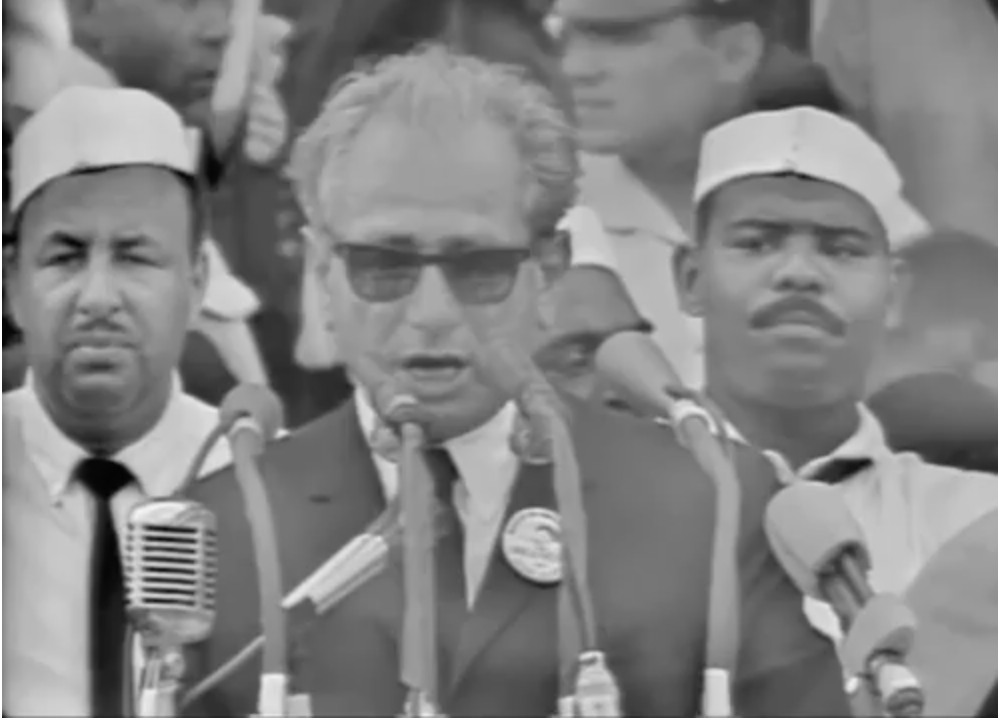
In 1963, Rabbi Prinz spoke at the March on Washington, right before Dr. Martin Luther King Jr. delivered his famous words. Prinz had been a rabbi in Berlin under the Hitler regime. He fled Nazi Germany, and he knew firsthand what happens when a society gets used to looking away. In his short remarks, he said, “The most urgent [problem] , the most disgraceful, the most shameful, and the most tragic problem is, silence.”
That line is a mirror. It keeps me honest and accountable.
Because silence is not always dramatic. Sometimes it is just convenient. Sometimes it is fatigue. Sometimes it is choosing comfort over awkwardness. Sometimes it is deciding, again, that someone else will say or do something.
We may not always have the time, access, or bandwidth for the big stance. But we all have chances for the small ones. And those small moments are not nothing. They are practice.
Rabbi Prinz also said, “When God created man, he created him as everybody’s neighbor. Neighbor is not a geographic term. It is a moral concept. It means our collective responsibility for the preservation of man’s dignity and integrity.” And even though this was said 62 years ago, it still feels uncomfortably current.
So here is my question for myself and for you on MLK Day this year: what does not being silent look like in the regular moments of our lives? What does it look like to treat our neighbors’ dignity as our responsibility?
Yes, small kindness matters. I try to build it into my daily routines: putting my shopping cart back so it does not roll into someone’s car and so an employee has one less cart to chase down; walking past a coin on the ground for the next person to find, because they might need it more than I do, or might just need that tiny spark of joy from finding a nickel in a parking lot; and offering a real smile to the barista before I order my chai latte, because I have no idea what kind of day they are having.
Here is the charge: watch the five minute and twenty-three second video of Rabbi Joachim Prinz in Chai Mitzvah’s Because We Were Slaves collection. Let one line stick with you. Then choose one small act this week that helps you not remain silent. What will yours be?
Jennifer Saber is the Manager of Community Engagement and Partnerships for Chai Mitzvah. Join tonight’s virtual event at 7:30pm Eastern: Because We Were Slaves: The Jewish Struggle for Justice in Making America Home. Click HERE to register.
Want to turn your act of community service into a POP (Power of Passion) project? If you are interested in forming or joining a Chai Mitzvah group and taking on POP, email info@chaimitzvah.org.
West Hartford, CT
860.206.8363
info@chaimitzvah.org


Copyright © 2026 Chai Mitzvah. All rights reserved. Website designed by Addicott Web.
Wonderful article!